

By TechPowerUp
Publication Date: 2026-06-09 17:15:00
Introduction
AMD Ryzen 9 9950X3D2 Dual Edition is the company’s ultimate AM5 desktop processor, and the first X3D chip to feature 3D V-Cache on both CCDs. Where the original Ryzen 9 9950X3D and 7950X3D had stacked cache on only one of their two chiplets, the 9950X3D2 eliminates that asymmetry, giving each CCD its own 96 MB L3 cache pool. This is a significant evolution that not only boosts gaming performance across all cores, but also promises to eliminate the software-level scheduling complexity that plagued dual-CCD X3D processors since the Ryzen 9 7950X3D. The “Dual Edition” branding reflects the dual 3D V-Cache configuration. It is a 16-core/32-thread processor with 192 MB of L3 cache—96 MB per CCD (32 MB on-die + 64 MB stacked). The 9950X3D2 offers clock speeds of 4.30 GHz base with up to 5.60 GHz boost, and comes with a TDP of 200 W. The default socket power limit (PPT) is 270 W, up from 200 W on the 9950X3D, with higher current limits to match (EDC 250 A, TDC 180 A). AMD recommends a 360 mm liquid cooler for this chip, compared to 240-280 mm for the 9950X3D.
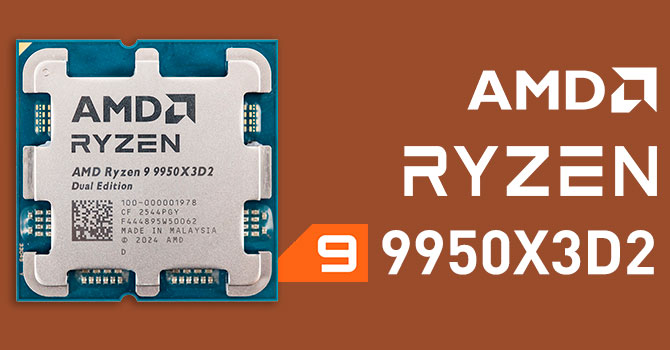
The 9950X3D2 is based on the same Granite Ridge platform as the rest of the Ryzen 9000 series, with two 8-core Zen 5 chiplets on the 4 nm TSMC N4P node, paired with a 6 nm I/O die. The key difference is that both CCDs now feature 3D V-Cache, so there is no longer a “fast CCD” and a “slow CCD” for gaming. AMD’s chipset driver still uses Game Bar to park CCD1 cores during gaming, but does it actually matter?…


.jpg?ssl=1 "Nexsan and Vates Unveil Joint Solution for Secure, High-Performance Virtualized Workloads")