By Metal Additive Manufacturing
Publication Date: 2026-03-05 15:28:00
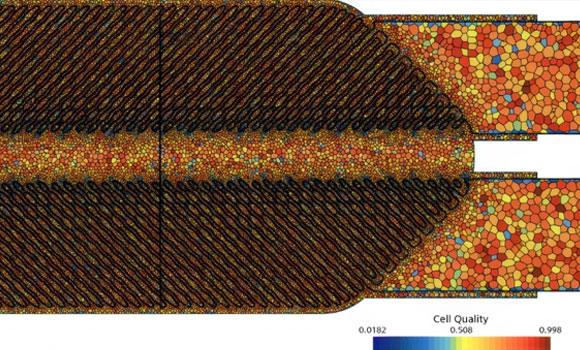
NVIDIA, headquartered in Santa Clara, California, USA, has published a case study focused on how aerospace component manufacturer Sintavia, based in Hollywood, Florida, has used GPU-accelerated simulation workflows to develop lightweight heat exchangers for aerospace and defence applications.
ADVERTISE WITH METAL AM
REACH ENGINEERS, DECISION-MAKERS AND INDUSTRY LEADERS SHAPING TECHNOLOGY ADOPTION
According to the report, Sintavia used NVIDIA’s RTX PRO 6000 Blackwell Workstation Edition GPUs in its high-performance workstations and NVIDIA data centre GPUs within its high-performance computing (HPC) clusters to support simulation-driven design. The study noted that the NVIDIA hardware was used alongside CUDA-enabled engineering software from nTop and Siemens, including Siemens’ Simcenter STAR-CCM+.
“Before, we were constrained by compute. Large simulations could take days – even weeks,” stated Jose Troitino, Principal Design Engineer at Sintavia. “With NVIDIA Blackwell GPUs, we have cut runtimes dramatically and scaled to models we never thought possible.”
The NVIDIA RTX PRO 6000 Blackwell Workstation Edition GPU includes 96 GB of GDDR7 memory and 24,064 CUDA cores, enabling simulations that previously