By Mohamed Abdel-Kareem
Publication Date: 2026-09-15 13:04:00
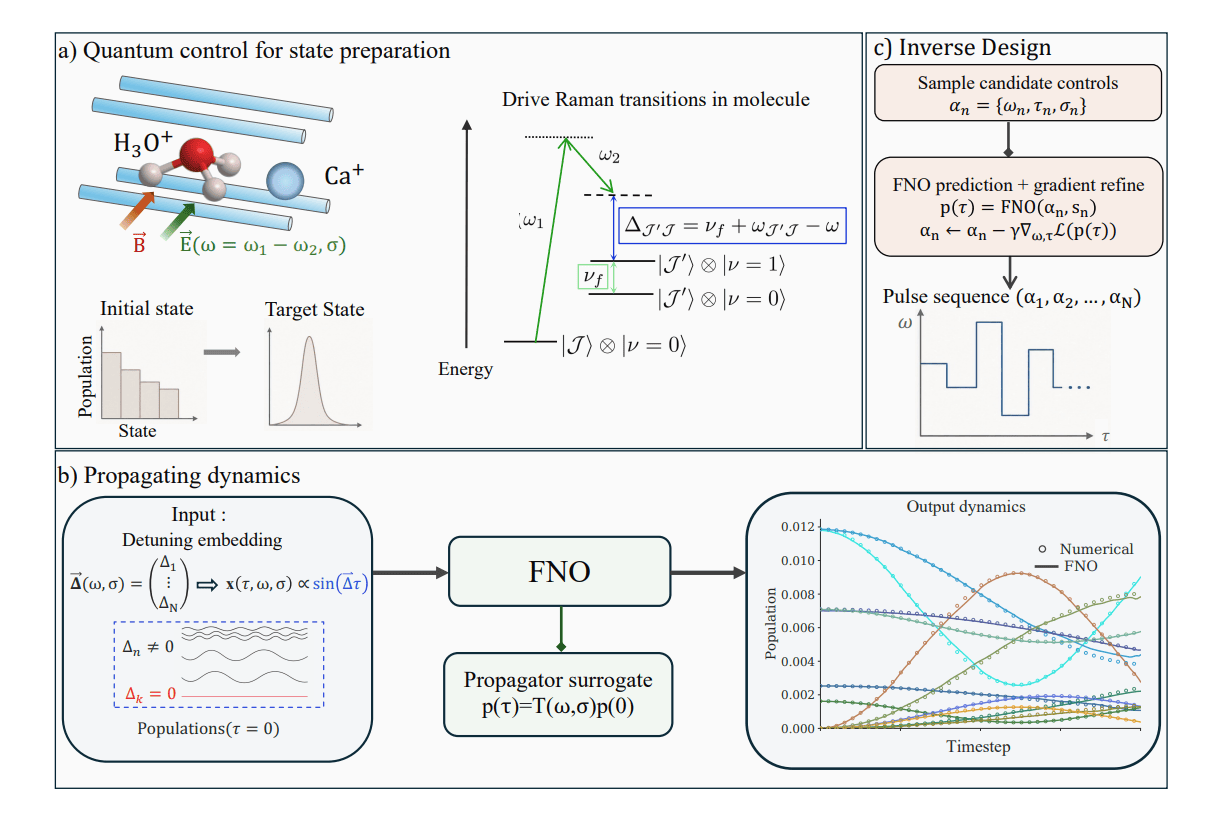
preparation. (b)Propagating single-pulse molecular dynamics with the FNO.
A multi-institution research collaboration led by UCLA (NarangLab), Caltech, and NVIDIA has introduced a machine-learning framework to automate the inverse design of quantum control pulse sequences. Detailed in a preprint published on arXiv (arXiv:2608.03702) and presented at IEEE Quantum Week 2026, the method utilizes a Fourier Neural Operator (FNO) to learn high-dimensional molecular quantum dynamics, replacing numerical differential equation solvers inside optimal control loops.
The FNO surrogate was trained on GPU-accelerated quantum state propagations generated by NVIDIA CUDA-Q Dynamics across an 888-dimensional Hilbert space modeling the trapped hydronium ion (H₃O⁺). Incorporating physics-informed frequency detuning embeddings and polarization symmetry constraints (σ⁺ and σ⁻ channels), the FNO surrogate predicts population trajectories across Raman sideband pulse windows up to ~10⁷× faster than accelerated GPU numerical propagation solvers. The surrogate is fully differentiable, enabling direct gradient-based optimization of continuous laser pulse parameters.
| [ FNO-SPMP Control Performance vs. Reinforcement Learning Baseline ] | ||
|---|---|---|
| Control Metric | Fourier Neural Operator (FNO-SPMP) | Standard Reinforcement Learning (RL) |
| Target State Fidelity & Success | • Target Population Density:… | |


