Main Points for Best Mac Virtual Machines Software, Tools & Guide
- Parallels Desktop is the best, most user-friendly, and feature-rich virtual machine solution for Mac users in 2024, particularly for those with Apple Silicon Macs.
- Virtual machines allow Mac users to run Windows, Linux, and other operating systems at the same time without needing to reboot, creating a seamless multi-OS workflow.
- Apple Silicon (M1/M2/M3) Macs need specific VM solutions like Parallels or UTM that support ARM architecture, while Intel Macs have more options including VirtualBox.
- Allocating resources like RAM and CPU cores properly is crucial for optimal VM performance—most VMs need at least 4GB RAM and 2 CPU cores to run smoothly.
- Free options like UTM and VirtualBox are available, but paid solutions like Parallels ($99.99/year) offer better integration with macOS and superior performance for demanding tasks.

Powered by Perplexity AI Comet – Try PRO FREE for 30 Days
Running Windows on your Mac doesn’t have to be a hassle or require a separate computer. With the right virtual machine software, you can easily switch between macOS and Windows (or Linux) without needing to restart your computer. MacKeeper experts recommend choosing a virtual machine that fits your specific needs, whether you’re a casual user, developer, or business professional who needs seamless integration between operating systems.
Virtual machines have come a long way in recent years, becoming more streamlined and user-friendly while using fewer system resources. This guide will take you through everything you need to know about choosing, setting up, and optimizing virtual machines on your Mac, whether you’re using the latest Apple Silicon model or an Intel-based Mac.
Why Mac Users Need Virtual Machines in 2024
Virtual machines are like separate computers within your Mac. They create a safe space for you to use software from other operating systems without worrying about compatibility or security issues. This is especially useful for Mac users who sometimes need to use Windows-only software but don’t want to buy a whole other computer just for that.
As Apple has shifted to its own silicon, eliminating the Boot Camp option that previously allowed dual-booting on Intel-based Macs, the technology has become increasingly important. Virtual machines are now the main way to run Windows on Apple Silicon Macs, making them a must-have tool for many professionals and power users.
Simultaneously Operate Windows, Linux, and Other Operating Systems
One of the most enticing benefits of virtual machines is the ability to operate multiple operating systems at the same time. Need to use a Windows-only application while keeping your Mac apps running? It’s not a problem. Virtual machines allow you to switch between operating systems with a simple click or keyboard shortcut, eliminating the need to restart your computer and close all your applications. This smooth transition keeps your workflow intact and greatly boosts productivity for cross-platform work.
Try Out Software Safely Without Risking Your Mac
Virtual machines give you a completely isolated environment to test software, visit potentially harmful websites, or run apps you’re not sure about. If anything goes wrong, such as a virus, a bug that breaks the system, or a software installation that conflicts with existing software, the problem stays in the virtual machine and doesn’t affect your main macOS system at all. For developers and IT professionals, this isolation is incredibly useful for testing software on different operating system versions without having to keep separate physical machines. For more insights, you can explore the best quantum computing technologies that are shaping the future.
Make the Most of Your System Resources with Today’s Virtualization
Virtual machine solutions have come a long way since their inception. Today’s virtualization technology leverages hardware acceleration features found in Intel and Apple Silicon processors, which lets virtual machines operate with minimal overhead. Features like memory ballooning ensure that RAM is dynamically allocated between your host system and virtual machines as required, optimizing resource usage. Many virtual machines also support sleep states and snapshots, which means you can pause virtual systems and pick up exactly where you left off, without using up resources when they’re not in use. For more insights, check out this guide on virtual machine software for Mac.
The 5 Best Virtual Machine Software for Mac
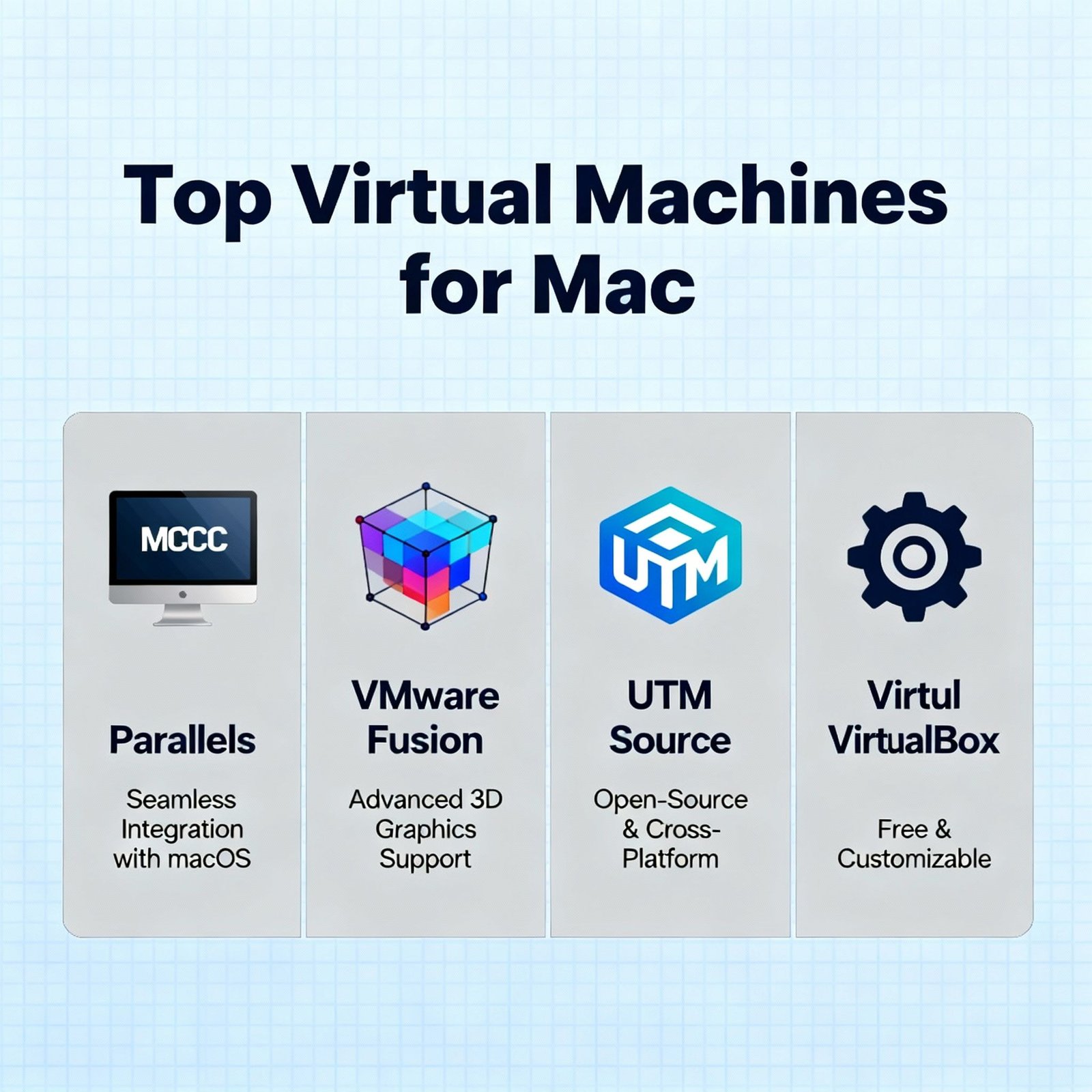
With Apple’s shift to its own silicon, the virtual machine landscape for Mac has changed dramatically. While some of the old standbys are still around, new players have entered the field, specifically tailored for Apple’s ARM-based architecture. This is a thorough examination of the top virtual machine choices for Mac users in 2024, taking into account elements such as performance, compatibility, user-friendliness, and cost.
1. Parallels Desktop: Top Choice for Mac Users
Parallels Desktop has positioned itself as the benchmark for Mac virtualization, especially since Apple’s shift to its own silicon. Being the first commercial solution to support Apple Silicon Macs, Parallels provides unrivaled macOS integration with features such as Coherence mode, which makes Windows apps look and behave like Mac apps. The software smartly manages resource allocation, causing less strain on battery life compared to other solutions. For those interested in broader technological trends, you might explore quantum computing technologies and their potential applications.
Both ARM-based Windows 11 and a wide range of Linux distributions specifically optimized for Apple Silicon are supported in the latest version. For Intel-based Macs, Parallels supports virtually any x86-based operating system. The software includes thoughtful touches like the ability to share clipboards between systems, drag-and-drop file transfers, and shared folders that make working between operating systems nearly seamless.
Parallels may not be the most affordable choice with a starting price of $99.99 for a yearly subscription ($129.99 for Pro and Business versions), but its superior performance and integration make it worth the cost for the majority of users. The Pro edition includes features that developers will find particularly useful, such as integration with developer tools like Visual Studio and increased allocation of virtual RAM and CPU cores.
2. VMware Fusion: Perfect for Business and Advanced Users
VMware Fusion has been a reliable name in virtualization for a long time, especially in business environments. Despite being slower than Parallels to support Apple Silicon, VMware now provides a capable solution for both Apple Silicon and Intel-based Macs. Fusion Player (for personal use) is free, while Fusion Pro costs $199 as a one-time purchase, making it potentially more cost-effective than Parallels for long-term use. The software excels in networking capabilities, snapshot management, and integration with VMware’s wider product ecosystem, making it perfect for IT professionals who manage multiple virtual environments.
3. VirtualBox: A Free Solution for Basic Virtualization
Oracle VM VirtualBox continues to be the top free, open-source virtualization option, but with a significant drawback: it only currently supports Intel-based Macs, with no official support for Apple Silicon. For those who are still using Intel Macs, VirtualBox offers capable, albeit slightly less polished, virtualization. It supports a broad range of guest operating systems and provides most of the essential features like shared folders and USB device support. The interface is less user-friendly than commercial alternatives, but comprehensive documentation and community support help to mitigate the learning curve.
4. UTM: Ideal for Apple Silicon Macs
UTM has become a potent open-source option specifically tailored for Apple Silicon. Built on QEMU, UTM provides two virtualization methods: complete hardware virtualization for ARM-based operating systems (such as Windows for ARM and ARM Linux distributions) and emulation for x86 operating systems (albeit with substantial performance drawbacks). The software can be obtained for free if downloaded directly from the project’s GitHub page, or for $9.99 via the Mac App Store (essentially a contribution to aid development). UTM’s interface is remarkably easy to use for an open-source solution, although it lacks some of the refinement and integration features seen in commercial alternatives.
5. Docker: A Lighter Option for Developers
Docker isn’t a traditional virtual machine, but it’s worth mentioning as a lighter virtualization option for developers. Docker uses containerization technology to package applications with their dependencies, which provides many of the benefits of virtualization with much less overhead. Docker is a good solution for developers who are working on cross-platform applications or need to test in specific environments, without the resource requirements of full virtual machines. Docker Desktop for Mac now supports both Intel and Apple Silicon Macs, although the transition to ARM required some adjustment for containers that were built for x86 architecture.
Virtualization on Apple Silicon Macs vs Intel Macs
The move from Intel to Apple Silicon is the biggest change in the Mac virtualization space in more than ten years. This shift in architecture has drastically changed compatibility and performance. Apple Silicon Macs (M1, M2, and M3 chips) use ARM architecture, which is very different from the x86 architecture that Intel processors use. This difference directly affects what virtual machines you can use on your Mac and how well they’ll run.
For Intel-based Macs, you have a variety of virtualization options, including older software like VirtualBox and dual-boot solutions like Boot Camp. However, for Apple Silicon Macs, you can only run virtual machines that are specifically designed or updated for ARM architecture. This primarily includes Parallels Desktop, VMware Fusion (newer versions), and UTM. On the bright side, ARM-based virtual machines often run more efficiently on Apple Silicon, providing better performance per watt than traditional x86 virtualization.
Performance Differences That Are Noticeable
In terms of real-world performance, Apple Silicon Macs running ARM-compatible virtual machines often outperform Intel Macs running x86 virtual machines. This is despite ARM virtualization being relatively new. An M1 MacBook Air running Windows 11 for ARM through Parallels can feel more responsive than an Intel i7 MacBook Pro running Windows 10 through the same software. The performance advantage comes from the efficiency of native ARM code execution and Apple’s highly optimized memory architecture.
When it comes to battery life and heat generation, the differences are quite significant. On Intel Macs, running virtual machines for a long time usually leads to a lot of battery drain and fan noise. However, Apple Silicon Macs can run virtual machines for hours without draining the battery too much and often without even turning on the fans. This efficiency makes ARM-based virtualization especially attractive for users who need to run virtual machines on the go.
Software Compatibility Overview
|
Virtual Machine Software |
Support for Intel Mac |
Support for Apple Silicon |
Support for Windows |
Support for Linux |
Cost |
|---|---|---|---|---|---|
|
Parallels Desktop 18 |
Yes (All x86 OSes) |
Yes (ARM OSes only) |
Windows 10/11 for ARM |
ARM Linux distributions |
$99.99/year |
|
VMware Fusion 13 |
Yes (All x86 OSes) |
Yes (ARM OSes only) |
Windows 11 for ARM |
ARM Linux distributions |
Free (Personal), $199 (Pro) |
|
VirtualBox 7 |
Yes (All x86 OSes) |
No |
Windows (x86 only) |
Linux (x86 only) |
Free |
|
UTM |
Limited |
Yes (Native ARM, emulated x86) |
Windows (ARM native, x86 emulated) |
Most distributions (ARM preferred) |
Free (GitHub), $9.99 (App Store) |
|
Docker Desktop |
Yes |
Yes |
N/A (containers only) |
N/A (containers only) |
Free (Personal), $5/month (Pro) |
Native ARM Support Update
The switch to ARM architecture has led to a complicated situation when it comes to operating system compatibility. Microsoft now officially supports Windows 11 for ARM for virtualization on Apple Silicon, but it requires a licensed copy (unlike the preview versions that were initially available). Most major Linux distributions now have ARM versions that run natively on Apple Silicon, including Ubuntu, Debian, and Fedora. However, for specialty distributions or older versions, x86 emulation may still be required through solutions like UTM, which comes with a significant hit to performance.
Native ARM support is a mixed bag for software within these operating systems. While Microsoft Office and many popular applications have been recompiled for ARM, specialized software—especially older programs—often still requires x86 emulation. The performance impact of emulation can range from barely noticeable for simple applications to prohibitively slow for resource-intensive software like video editors or 3D modeling tools. When planning your virtualization strategy, it’s crucial to research ARM compatibility for your specific software needs.
Setting Up Your First Virtual Machine on Mac
Creating your first virtual machine can be daunting, but the process has been made much simpler with the help of modern virtualization software. Most of these solutions now come with wizards that walk you through each step, from choosing your operating system to allocating resources. Before you start, make sure you have enough storage space (at least 50GB for Windows is recommended) and a reliable internet connection for downloading operating system files. You’ll also need an installation medium or an ISO file for your chosen operating system, though some virtualization software can download these for you.
Step-by-Step Installation Guide
Start by downloading and installing your chosen virtualization solution—Parallels Desktop offers the most straightforward experience for beginners. Launch the application and select “Install Windows” or “Create New” depending on your preferred operating system. For Windows installations, modern virtualization software can typically download and install Windows automatically with minimal user intervention. For Linux or other systems, you’ll need to provide an ISO file or installation media. Follow the on-screen prompts to select installation options like language and edition, then wait while the virtual machine is created and the operating system is installed. This process typically takes 20-40 minutes depending on your Mac’s performance and internet speed.
Once the installation process is done, most virtualization software will automatically install additional integration tools. These tools provide features such as clipboard sharing, drag-and-drop file transfer, and improved graphics performance, which enhance the virtual machine experience. If you are asked to install these tools, always say yes. They are crucial for the best performance and usability. Lastly, spend a few minutes getting to know the control panel of your virtualization software. Familiarize yourself with the options for starting, stopping, and configuring your virtual machine.
Resource Allocation: RAM, CPU, and Storage
It’s vital to allocate resources correctly for optimum performance of a virtual machine. As a general rule, you should allocate at least 4GB of RAM for Windows 10/11 and 2GB for most Linux distributions, while ensuring that your host macOS retains at least 4GB. CPU allocation usually defaults to half of your available cores, which is fine for most users. When it comes to storage configuration, you have two main options: dynamically allocated disks that grow as you need them (saving space but potentially causing fragmentation) or fixed-size disks that perform better but take up space immediately. To avoid running out of space after installing applications and updates, allocate at least 64GB for Windows and 20GB for Linux. For more insights on optimizing AI infrastructure, you can explore how to streamline AI infrastructure with NVIDIA and Microsoft Azure.
Options for Network Configuration
There are three main networking modes that most virtual machines offer, each with its own unique benefits. Shared networking (NAT) is the default and most user-friendly option. It allows your virtual machine to share your Mac’s internet connection while remaining hidden to other devices on your network. Bridged networking allows your virtual machine to appear as a separate device on your network with its own IP address. This is useful for testing server applications or in instances where the virtual machine needs to be accessible from other devices. Host-only networking creates a secure network between your Mac and virtual machine without external internet access. This offers the highest level of security for sensitive development or testing. For the majority of users, the default shared networking mode offers the best blend of convenience and functionality.
Transferring Files and Sharing Folders
Being able to share files effectively between your Mac and virtual machines is crucial for maintaining efficient workflows. There are several methods for transferring files that most virtualization solutions offer. Shared folders are the most straightforward option, as they let you specify Mac folders that show up as network drives within your virtual machine. These give you easy access to files from both systems, but they can sometimes struggle with performance issues when dealing with large files. Drag-and-drop functionality provides a quick and easy way to transfer individual files directly between windows when you’re using your virtual machine in windowed mode rather than full-screen.
Parallels users can enjoy a more integrated experience as they can open Mac files directly in Windows applications and vice versa. For instance, they can right-click a Windows document in Finder and open it directly in a Windows application. This level of integration creates an almost seamless experience that blurs the line between operating systems. For VMware Fusion and VirtualBox, you might need to perform additional configuration steps to enable the most advanced sharing features, but there are comprehensive documentation guides to help you through these processes.
Cloud storage platforms such as Dropbox, OneDrive, or iCloud Drive are great for bridging the gap between systems, especially if you’re working with multiple virtual machines. By setting up these services on both your host Mac and within your virtual machines, your files will stay synced no matter which system you’re on. This is especially helpful for people who often switch between operating systems or need to have consistent access to project files across different environments.
If you need to transfer files and shared folders aren’t set up, you can always use USB drives. Most virtual machine software lets you connect USB devices straight to your virtual machine, which disconnects them from macOS. This is a good method for transferring large files, but it does mean you have to connect and disconnect the drive every time you switch between systems.
- Shared folders: Best for continuous access to files from both systems
- Drag-and-drop: Convenient for quick transfers of individual files
- Cloud storage: Excellent for synchronizing files across multiple systems
- USB drives: Reliable for large file transfers or when other methods aren’t available
- Network file sharing: Useful when virtual machines need to access files from each other
Boost Virtual Machine Performance on Your Mac
Even the most powerful Mac can struggle when running demanding applications in a virtual machine. Fortunately, several optimization techniques can dramatically improve performance without requiring hardware upgrades. The key areas to focus on are memory management, storage configuration, and graphics settings. By fine-tuning these elements, you can often achieve near-native performance for many applications while minimizing impact on your host system.
Before you start tweaking anything, get a baseline for how your typical workload performs. Look for any lag, stuttering, or slowdowns. This baseline will help you see the impact of each optimization and which ones help the most for your specific use case. Keep in mind that virtual machine performance is highly dependent on your workload. An optimization that helps one application a lot might not help another application much at all.
How to Optimize Memory
One of the most important factors that can affect the performance of your virtual machine is how you allocate your RAM. If you allocate too little, your VM will constantly be swapping to disk, which can cause major slowdowns. If you allocate too much, you’ll be depriving your host macOS of the resources it needs. For Windows 10/11, you should allocate at least 4GB for basic productivity and 8GB for more intensive applications. Most virtualization software now has dynamic memory allocation, which automatically adjusts your RAM based on demand. This feature can greatly improve your overall system performance by taking back unused memory when it can. Learn more about quantum computing technologies and their impact on virtualization.
Modern virtualization platforms offer a powerful technique called memory compression. This feature compresses memory pages that are rarely used instead of writing them to disk. This provides a performance that is similar to having more physical RAM. In Parallels, this feature is referred to as “Adaptive Hypervisor.” In VMware, it is called “Memory Trimming.” By enabling these features, you can significantly improve performance when you are running multiple virtual machines at the same time or when you are working with applications that are memory-intensive.
Adjusting Graphic Acceleration Settings
Most modern virtual machines have the ability to support hardware-accelerated graphics, which means they can use your Mac’s GPU to render graphics. This feature is especially important for applications that have complex interfaces, video playback, or light 3D work. For Parallels users, make sure 3D acceleration is enabled and set to “Auto” or “Metal” for Apple Silicon Macs. For VMware Fusion users, make sure “Accelerate 3D Graphics” is enabled and allocate at least 1GB of graphics memory. For VirtualBox users, enable 3D acceleration and try out different memory allocations to see which one works best.
If you’re using applications that are heavy on graphics, you can boost performance by giving them more video memory. But there’s a catch: the more video memory you allocate, the less RAM there is for your virtual machine and host system. Start with the default allocation and then increase it little by little, keeping an eye on performance. If your host system starts to slow down, you might have allocated too much video memory.
How SSD and HDD Storage Affects Your VM
The storage configuration of your virtual machine can greatly affect its performance, especially for disk-heavy tasks such as booting up, launching applications, or handling large files. If you store your virtual machine on an SSD instead of a regular hard drive, you can boost performance by 5-10x for many tasks. If you can, set aside a specific SSD or partition for your virtual machines to reduce fragmentation and maintain steady performance. Some people even choose to use external Thunderbolt SSDs exclusively for their virtual machines, which offers great performance while saving internal storage.
Aside from physical storage considerations, the format of your virtual disk is also important. Most virtualization platforms give you a choice between dynamically expanding disks, which grow as needed, and fixed-size disks, which allocate all space immediately. Dynamic disks are more convenient and space-efficient, but fixed-size disks usually offer better performance, especially for disk-intensive workloads. If performance is your main concern and you’re not limited by storage space, creating fixed-size virtual disks can lead to noticeable improvements in responsiveness and application launch times.
Top Tips for Mac Virtualization
Good virtualization practices can help you avoid a lot of common issues while also ensuring the best performance and data security. Begin by setting up a regular maintenance routine for your virtual machines. This should include updates, disk cleanup, and performance optimization. Virtual machines, like physical computers, benefit from regular maintenance. This helps to avoid a decline in performance over time. Creating a systematic approach to managing your virtual machines will save you time and hassle in the future.
How to Create and Manage Snapshots
One of the most powerful features of virtualization is the ability to create snapshots, which allow you to save the exact state of a virtual machine at a specific point in time. This is a great safety net to have in place before making significant changes like installing new software, updating the operating system, or modifying system configurations. If anything goes wrong, you can revert to the snapshot in seconds rather than spending hours troubleshooting or reinstalling. However, snapshots do consume storage space and can impact performance if overused, so be sure to delete them when they’re no longer needed. For more insights on technology trends, you can explore our guide on quantum computing technologies.
Develop a snapshot strategy based on your specific needs. For development environments, consider creating snapshots at key milestones or before integrating new components. For testing environments, maintain snapshots of clean system states to ensure consistent baseline conditions. Remember that snapshots create a branching structure—you can have multiple snapshots from different points in time and switch between them as needed. This capability is particularly valuable for software testing across different configurations or for educational environments where systems need to be reset frequently.
Virtual Machine Backup Strategies
While snapshots offer a way to recover data from a specific point in time within a virtual machine, they don’t protect against catastrophic failures like disk corruption or hardware failures. Implement a backup strategy that includes regular backups of entire virtual machines to external storage. Most virtualization platforms allow you to export virtual machines as single files, making backup relatively straightforward. Time Machine can back up virtual machine files, but dedicated backup solutions often provide more reliable and efficient options specifically designed for large, frequently-changing files.
By storing virtual machine backups off-site, cloud backup services can provide an extra layer of protection. This method not only protects against local disasters but also allows you to restore virtual machines to different hardware if needed. For critical virtual machines, you might want to consider a 3-2-1 backup strategy: three copies of your data, on two different types of media, with one copy stored off-site. This method offers strong protection against virtually any scenario, barring a worldwide catastrophe.
Security Concerns
Virtual machines come with their own set of security issues and advantages. They offer great isolation, which can keep potential malware infections contained within the virtual environment. However, they also tend to have less security than physical systems. Treat virtual machines as you would physical computers when it comes to security—keep the operating system and applications up to date, install security software, and use strong passwords. You should also think about security measures that are specific to virtualization, like encrypting virtual disk files to stop unauthorized access.
While shared folders and clipboard integration are handy, they can also create security vulnerabilities by creating pathways between isolated environments. Be conservative in how you configure these features, only enabling them when needed and with the appropriate limitations. If you’re working in a sensitive environment and need maximum security, consider disabling shared folders altogether and use alternative file transfer methods like encrypted cloud storage or secure file transfer protocols. Keep in mind that there’s often a trade-off between security and convenience. Evaluate your specific needs and adjust your configurations accordingly, especially when dealing with Amazon Web Services or other cloud platforms.
Practical Applications of Mac Virtual Machines
Mac virtual machines are more than just a way to run Windows apps. They’re a tool for creative professionals who need to test designs across different operating systems to ensure they look and function the same way. They’re a sandbox for cybersecurity professionals who need to analyze malware and test security configurations without putting their main systems at risk. They’re a command center for IT administrators who need to manage multiple server environments from a single MacBook. By understanding these varied use cases, you can find new ways to use virtualization technology in your own work.
Software Development and Testing
Developers find virtual machines to be incredibly useful for testing environments that are identical to production configurations. Web developers can test sites across multiple browsers and operating system combinations without having to maintain a lab of physical machines. Mobile developers can run emulators for different device configurations simultaneously, making the testing process more efficient. Virtual machines also allow for the easy creation of clean development environments with precisely controlled dependencies, preventing the common “it works on my machine” issue that many development teams run into. To explore how AI can enhance these processes, you might want to read about streamlining AI infrastructure with NVIDIA.
Virtualization is particularly beneficial to DevOps professionals, who use it to create reproducible infrastructure with tools like Vagrant that automatically set up development environments. These environments can precisely match production servers, ensuring that code behaves the same way across all stages of deployment. Virtual machines also support containerization workflows through Docker Desktop for Mac, which runs in a lightweight virtual machine to provide Linux container functionality on macOS.
Operating Windows-Exclusive Programs
While there are more and more software options that work on both Windows and Mac, there are still many specialized programs that only run on Windows, especially in industries like finance, engineering, and business management. Virtual machines allow these programs to be used without needing a separate Windows computer. This means that accountants can use special tax programs during tax season without having to switch computers. Engineers can use CAD programs that aren’t available on Mac. Healthcare professionals can use older medical systems that only work on Windows. This is especially useful for Mac users who need to use Windows-specific software every once in a while, but don’t want to have to keep a separate computer just for that.
Schools and Universities
Virtual machines can be a powerful tool in a learning environment. For example, a computer science teacher can provide students with a pre-set development environment that will work the same no matter what kind of computer the student is using. In an information security class, students can safely learn how to exploit and analyze vulnerabilities without causing any real harm. In a system administration class, students can create a virtual network with multiple machines all running on a single laptop. This can greatly reduce the amount of hardware needed for technical education and provide a more flexible and realistic learning environment.
Support for Outdated Software
As operating systems continue to advance, they often leave behind older software that isn’t compatible with the new versions. Virtual machines offer a neat solution to this problem by letting you run older operating systems that have been specifically configured to run outdated applications. This allows researchers to use specialist scientific software that is tied to specific versions of Windows. It also enables digital archivists to run old file formats and applications that are necessary for accessing historical documents. Businesses can also continue to use custom software that has been developed specifically for their needs, even if the original developers are no longer around. This is particularly useful during transition periods, such as Apple’s move from Intel to Apple Silicon, as it allows for compatibility gaps to be bridged until native solutions are available.
What to Do When Your Mac VM Stops Working
Even the most carefully configured virtual machines occasionally encounter problems. When issues arise, a systematic troubleshooting approach can quickly identify and resolve most problems without data loss or significant downtime. Start with the simplest potential solutions before progressing to more complex or time-consuming approaches. Often, simple steps like restarting the virtual machine or reinstalling integration tools resolve common issues without requiring more drastic measures.
Typical Problems and How to Fix Them
Performance issues are the most common problem with virtual machines. First, make sure you’ve allocated enough resources—too little RAM or too few CPU cores can cause your machine to run slowly. Next, check the disk space on both the virtual machine and the host system; if either one is near capacity, your virtual machine may run poorly. Fragmented virtual disks can also slow things down; luckily, most virtualization platforms come with tools to optimize or compact virtual disks. Finally, check for background processes running on your virtual machine, especially security software or update services that might be hogging resources.
How to Fix Resource Conflicts
Resource conflicts happen when more than one application tries to use the same hardware resources, which can lead to poor performance or stability problems. These conflicts often involve USB devices, network ports, or specialized hardware. If a USB device isn’t working correctly or isn’t recognized in your virtual machine, try disconnecting and reconnecting it through the menu of your virtualization software instead of physically unplugging it. This forces the virtual machine to start the device connection over, which can often fix recognition issues.
Most of the time, network problems will show up as connection issues within the virtual machine, even though the host Mac is connected to the internet. To begin with, check your virtual machine’s network configuration to make sure it is set up the way you want it to be (NAT, bridged, or host-only). If you’re still having trouble, you might want to try resetting the virtual network adapter. You can do this by changing its type (for example, from NAT to bridged) and then changing it back. If you’re still having network problems after trying these steps, some people have had success by creating a new virtual machine and moving their data over to it. This is because network configurations can sometimes get messed up in ways that are hard to diagnose directly.
Choosing Between Repair and Reinstallation
If you’re dealing with ongoing issues, you’ll have to choose between fixing your current virtual machine or making a new one. Most virtualization platforms have repair options that can address typical problems without losing data. In Parallels, you can find these tools under “Virtual Machine” → “Configure” → “Options” → “Troubleshooting.” VMware Fusion provides similar utilities under the “Virtual Machine” menu. These repair features can solve many problems related to virtual hardware, network configurations, or integration components without the need for a full reinstallation.
If your repair utilities aren’t doing the trick, you may need to consider creating a new virtual machine. Instead of starting from the very beginning, most virtualization platforms allow you to mount the virtual disk from your problematic VM as a secondary disk in a new virtual machine. This method allows you to keep your data and installed applications while creating a fresh virtual hardware configuration. While it may take more time than repairs, this method can resolve even the most stubborn issues without losing important files or configurations. Make sure to create a backup copy of your virtual disk file before you try this method to avoid any accidental data loss during the migration process.
Virtual Machines versus Other Options
Comparing Various Methods of Accessing Windows on a Mac
Virtual Machines: This software allows you to run Windows within macOS. You can switch between the two instantly without needing to restart your computer. It performs well for most tasks, but it’s not recommended for gaming or 3D modeling. You’ll need 8-16GB of RAM for optimal performance. The cost can range from free to over $99 per year.
Boot Camp (Only for Intel Macs): This provides native Windows performance but you need to restart to switch OS. It is perfect for gaming and applications that require a lot of resources. It does require a partition of the internal drive. It is free (excluding the cost of the Windows license).
Cloud Windows: This is a remote access to Windows in the cloud. It does not use local resources but it does require a fast internet connection. The pricing is usually a subscription of $10-30 per month. This is best for occasional Windows use.
Wine/CrossOver: This software allows you to run Windows applications without needing the Windows operating system. The compatibility can vary, and you don’t need a Windows license. The performance can range from native to unusable, depending on the application. CrossOver costs $74 per year.
Virtual machines are the most flexible way to run other operating systems on your Mac, but they’re not the only game in town. Other options exist, each with its own strengths that make it the best choice for certain situations. Knowing what these alternatives are can help you pick the right tool for the job, which could save you money, get you better performance, or make things less complicated than full virtualization.
Choosing the best approach often depends on your specific needs, especially how often you’ll use it, your performance needs, and the specific apps you need to run. If you’re only occasionally using simple Windows apps, a cloud solution or compatibility layer might be the most convenient. If you’re frequently using intensive apps, Boot Camp (on Intel Macs) or a dedicated virtual machine might be a better fit. Many people end up using multiple approaches for different scenarios. For example, you might use Boot Camp for gaming and keep a virtual machine around for business apps.
What you choose will also be influenced by what your hardware can handle and whether you’re willing to pay for extra software or services. Those with older Macs or not much RAM might find that cloud solutions are more practical than resource-heavy local virtualization. On the other hand, those with high-end hardware can get almost native performance with properly set up virtual machines, making them the most flexible choice for power users.
Comparing Boot Camp and Virtual Machines
Boot Camp is a unique feature available only on Intel-based Macs. It allows you to install Windows on your Mac, right next to macOS. You can then choose which operating system you want to use when you start your computer. This approach gives you 100% native performance. That’s because Windows is running directly on your hardware, without any virtualization overhead. Boot Camp is especially useful for applications that need a lot of resources. Examples include games, 3D rendering software, and video editing tools. These applications benefit from having direct access to your hardware. The difference in performance is most noticeable in applications that use a lot of graphics. In these cases, Boot Camp can give you 2-3 times the performance of even the best virtual machine setups.
Nonetheless, Boot Camp’s main drawback is that you can’t run macOS and Windows at the same time. Switching operating systems necessitates a full reboot, which closes all applications and disrupts your workflow. This restriction makes Boot Camp unsuitable for users who need to switch between operating systems frequently or who need to transfer data between them. Furthermore, Boot Camp necessitates partitioning your internal drive, which could limit storage space for both operating systems. With Apple’s transition to Apple Silicon, Boot Camp is no longer an option for newer Macs, leaving virtualization as the only local solution for running Windows.
Choosing between Boot Camp and virtualization often boils down to whether you need performance or convenience. Boot Camp offers superior performance, which is particularly useful if you use Windows for gaming or other applications that require a lot of processing power. It’s also a good choice if you don’t need to switch between operating systems frequently. On the other hand, if you need to use both operating systems regularly or need to transfer data between them seamlessly, virtualization is much more convenient, despite the slightly reduced performance. Many advanced users used to maintain both configurations before Apple Silicon came along, using Boot Camp for applications that required a lot of processing power and a virtual machine for convenience.
- Boot Camp provides native performance but requires restarting to switch OS
- Virtual machines allow simultaneous OS use but with some performance overhead
- Boot Camp is better for gaming and graphics-intensive applications
- Virtual machines are superior for productivity and development workflows
- Boot Camp is not available on Apple Silicon Macs
Cloud-Based Solutions Comparison
Cloud-based Windows solutions like Windows 365, Shadow PC, and Amazon WorkSpaces provide remote access to Windows environments running on servers rather than your local Mac. These services stream the Windows desktop to your Mac through an application or web browser, with all processing occurring in the cloud. This approach offers several advantages: no local resource consumption, access from any device with an internet connection, and automatic hardware upgrades managed by the provider. Cloud solutions are particularly appealing for users with less powerful Macs or those who need Windows access from multiple devices.
The main downside of cloud Windows is that it relies on internet connectivity—if your connection isn’t stable or high-speed, it can be frustrating or impossible to use. Latency can make apps that need a lot of resources feel less responsive than local options, especially for tasks that need a lot of graphics. The cost structure is also a lot different from local virtualization, with monthly subscription fees usually between $10 and $40 depending on how much performance you need. Over time, these subscriptions can end up costing more than buying virtualization software, but they get rid of the need to buy a Windows license on your own. If you only need to use Windows sometimes or you have multiple devices, cloud solutions can be a cost-effective way to get the flexibility you need without using up your local resources.
Wine and CrossOver: A Different Approach for Mac Users
Wine (which stands for Wine Is Not an Emulator) and its commercial version CrossOver use a unique approach to enable Mac users to run Windows software. Instead of virtualizing an entire Windows operating system, these compatibility layers translate Windows API calls into macOS equivalents. This allows Windows applications to run natively, without needing Windows itself. This method has several benefits: it doesn’t require a Windows license, it uses fewer resources compared to full virtualization, and it often provides better performance for supported applications. CrossOver, in particular, offers a user-friendly interface that makes installation and configuration easier than the more technical Wine project.
While Wine and CrossOver do support thousands of applications, their primary drawback is application compatibility. Many programs either do not function as they should or require a lot of configuration to get them to work. This compatibility varies greatly between different applications and even between different versions of the same application. Programs that depend on specific Windows features or drivers often run into issues that are not easily resolved. Additionally, applications receive different levels of support. Popular software like Microsoft Office or Adobe products typically work well, while specialized or obscure applications may not work at all.
Wine and CrossOver are especially useful for users who only need specific Windows applications rather than the entire Windows experience. Gamers frequently use these tools to play Windows games on Mac without the burden of a full virtual machine. Business users may find them appropriate for running specific Windows-only utilities or legacy applications that don’t have Mac equivalents. The main attraction is simplicity – when compatibility is high, these tools enable Windows applications to operate as if they were native Mac applications, showing up in your Dock and integrating with macOS features like file associations.
- No Windows license required, saving $100+ compared to virtualization
- Lower resource usage than full virtual machines
- Better integration with macOS for supported applications
- Variable compatibility—works perfectly for some apps, not at all for others
- CrossOver provides commercial support and a user-friendly interface
Cost Comparison: Free vs. Paid Mac Virtualization Tools
Virtualization solutions range from completely free open-source options to premium commercial products with annual subscription fees exceeding $100. This price spectrum reflects significant differences in features, performance, ease of use, and support. Free solutions like UTM and VirtualBox provide basic virtualization capabilities without cost but typically require more technical knowledge and offer fewer integration features. Commercial solutions like Parallels Desktop and VMware Fusion command premium prices but provide refined user experiences with extensive macOS integration, automated setup, and professional support options. Your choice should balance budget constraints against feature requirements and the value of your time spent configuring and maintaining your virtual environment.
Understanding Value for Different Types of Users
For casual users who only need to access Windows applications occasionally, free solutions are often sufficient. The time it takes to set up these tools is reasonable for infrequent use, and they offer basic functionality like running Office applications or accessing Windows-only websites. However, power users and professionals often find that commercial solutions offer better value despite the higher upfront costs. The improved performance, seamless integration with workflows, and time savings from automated setup and maintenance make the premium price worth it for users who rely on virtualization on a daily basis. For businesses, the decision is even more straightforward—professional support, reliability, and employee productivity often outweigh the cost of licensing, making commercial solutions the standard choice in business settings.
Subscription or One-Time Purchase: Which is Better?
As the virtualization market increasingly moves towards subscription-based pricing models, it is important to consider the long-term value. Parallels Desktop is now entirely subscription-based ($99.99/year for Standard, $129.99/year for Pro), while VMware Fusion offers both subscription and perpetual license options ($199 one-time purchase). While subscription models offer ongoing updates and support, they may end up costing more in the long run for users who keep the same virtual machine configuration for several years. On the other hand, perpetual licenses may offer better long-term value for those who don’t plan on changing their setup, but they may require paid upgrades to stay compatible with future macOS versions. If you’re planning on using virtualization for more than two years and don’t need the latest features, you may find that a perpetual license or a free alternative can save you money compared to a subscription service.
Final Thoughts: Choosing the Best Mac Virtual Machine for Your Needs
- Best Overall: Parallels Desktop is the top choice for its excellent performance and macOS integration, especially for Apple Silicon Macs.
- Best for Enterprise: VMware Fusion is the best for enterprise integration, snapshot management, and optional perpetual licensing.
- Best Free Option: UTM offers capable virtualization for both ARM and x86 operating systems at no cost.
- Best for Developers: Docker is ideal for development workflows as it provides lightweight containerization without the full OS virtualization overhead.
- Best for Gamers: Boot Camp (Intel Macs only) is still the best for gaming performance where available.
The best virtualization solution for you will depend on your specific needs, technical requirements, and budget. For most users, Parallels Desktop is the best overall choice despite its subscription pricing model. It integrates seamlessly with macOS, has an automated setup process, and is optimized for performance on both Intel and Apple Silicon Macs. It sets the standard for other solutions. The coherence mode, which allows Windows applications to appear alongside Mac applications, is especially useful for users who frequently switch between operating systems.
For power users with specialized needs, other options might be more appealing. VMware Fusion, for example, excels in snapshot management and enterprise integration, making it a go-to for IT professionals who need to juggle multiple virtual environments. UTM, on the other hand, offers competent free virtualization for both ARM and x86 operating systems, making it a top pick for users on a budget or those who only need basic virtualization. And for developers who are more interested in containerization than full OS virtualization, Docker is a lightweight, efficient option that plays nicely with modern development workflows.
No matter which option you go for, virtual machines have revolutionized the way Mac users engage with other operating systems. Being able to run Windows, Linux, and other environments smoothly without having to restart or keep separate physical machines has greatly improved productivity. As Apple continues to transition to its own silicon, virtualization technology will continue to be vital for keeping compatibility with the wider computing ecosystem while taking advantage of the benefits of Apple’s groundbreaking hardware.
Commonly Asked Questions
For those new to the world of virtual machines on Mac, it’s normal to have a few questions. We’ve compiled a list of answers to the most common questions, based on search data and user forums. Every virtualization scenario is different, but these general guidelines will give you a good idea of what you can do, what you can’t do, and what you’ll need to run virtual machines on a Mac.
Don’t forget that virtualization technology is constantly changing, especially as Apple continues to transition to its own silicon. Features, performance, and compatibility can all change with new software releases or hardware generations. For the most up-to-date information, check the documentation for your specific virtualization solution and stay informed by participating in user communities dedicated to Mac virtualization.
Does running a virtual machine slow down my Mac?
Running a virtual machine will affect the performance of your Mac to a certain extent, but the impact is minimized with modern virtualization technology when it is properly configured. The effect on performance is mainly dependent on resource allocation—when you allocate more RAM and CPU cores to your virtual machine, it leaves fewer resources for macOS, which could slow down your host system. If you want to get the best performance, you should make sure that your Mac has at least 16GB of RAM if you are regularly running Windows virtual machines, and you should close any unnecessary applications on both your host and guest systems. The good news is that modern virtualization software is now extremely efficient, allowing most Macs to run virtual machines with a minimal noticeable impact during normal productivity tasks.
Is it possible to run macOS within a virtual machine on my Mac?
Indeed, you can virtualize macOS on Mac hardware, although there are some restrictions due to Apple’s licensing terms. Apple’s software license agreement only allows macOS to be virtualized on Mac hardware, and only with legally obtained copies of macOS from Apple. This feature is especially handy for developers who need to test applications across various macOS versions or system configurations without the need for multiple physical machines. Both Parallels Desktop and VMware Fusion support macOS virtualization and offer simplified setup processes that automatically configure the virtual machine correctly.
There are limited benefits to virtualizing the same macOS version that is currently running on your Mac for most users. However, virtualizing older macOS versions can be valuable for testing compatibility with legacy software or maintaining access to features removed from newer releases. Developers find this capability particularly useful for ensuring applications work correctly across multiple macOS versions without maintaining separate physical test machines for each version.
- Both Intel and Apple Silicon Macs can virtualize macOS Monterey and newer versions
- Intel Macs can virtualize earlier versions like Catalina and Mojave
- Apple’s license terms are violated by the virtualization of macOS on non-Apple hardware
- Virtualized macOS performance is generally good, but not identical to native installation
Running multiple concurrent macOS virtual machines is technically possible, but it can quickly consume available system resources, particularly RAM and CPU cores. For intensive testing scenarios, cloud-based testing services often provide more scalable solutions than local virtualization. This allows access to multiple macOS environments without overtaxing your local hardware.
Do I need to purchase a Windows license to run Windows on my Mac?
Yes, you must have a valid Windows license to run Windows legally in a virtual machine, just as you would if you were installing Windows on a PC. Microsoft does not provide free Windows licenses for virtualization scenarios, although they do offer evaluation versions for temporary testing. If you plan to use it for an extended period, you will need to buy a Windows license, usually Windows 10 or 11 Home edition is sufficient for most users, while Pro editions offer additional features that are valuable in business environments. Licenses can be purchased directly from Microsoft, from retail outlets, or occasionally at a discount through educational institutions for eligible students and faculty.
When buying a Windows license, it’s often easier to opt for a digital license over a physical installation media because most virtualization software can download and install Windows automatically. Also, remember that Windows licenses are tied to specific editions—Home, Pro, or Enterprise—and these editions come with different features. Most individual users find the Windows Home edition to be enough, while business users may need the Pro edition for features like Remote Desktop hosting. Once bought, a single Windows license can legally be installed in one virtual machine at a time, just like it would be limited to one physical PC.
Can I play games in a Windows virtual machine on my Mac?
Yes, you can play games in a Windows virtual machine on your Mac, but the performance won’t be as good as if you were running Windows natively on your machine. Virtual machines can’t use all of a GPU’s resources, so 3D games will have lower frame rates and visual quality. Simple or older games might run fine, especially on high-end Macs with dedicated graphics cards, but newer, more demanding games will probably run poorly. If you’re serious about gaming on your Mac, you should use Boot Camp (if you have an Intel Mac) because it lets Windows use your hardware resources directly, without the overhead of virtualization. If you have an Apple Silicon Mac, your options are more limited, but you can use cloud gaming services like NVIDIA GeForce Now or Xbox Cloud Gaming to get around the limitations of your local hardware.
How much storage do I need for a virtual machine?
A basic Windows virtual machine with the necessary applications will need at least 64GB of storage space. This includes space for the operating system (which needs about 20GB), updates, and common applications like Office. If you’re setting up a development environment or a system with a lot of applications, you’ll want to have 100-128GB to give yourself some breathing room. Most modern virtualization software uses dynamically expanding virtual disks, which only use up physical space as needed. This means you can set your virtual disk sizes to be quite large without immediately using up all that physical space.
Keep in mind that over time, Windows updates and installing new applications will gradually take up more space. A virtual machine that initially only uses 25GB might grow to 40-50GB after several months of updates and installing new applications. Planning for this growth can help avoid the frustration of running out of space when it’s least convenient. Some virtualization software offers disk cleanup and optimization utilities that can reclaim space by compacting the virtual disk file after you delete content within the virtual machine.
Virtualization software doesn’t just create a virtual disk. It also creates files for system state, snapshots, and configuration data. These files can take up a lot of space, especially if you use snapshots a lot. A typical virtual machine with a few snapshots might need 20-30% more space than just the virtual disk. For critical virtual machines, you should also consider space for backups. You should ideally store these on separate physical storage for the best data protection.
When you’re short on storage space, you might want to think about getting some external storage. If you have a modern Mac with a Thunderbolt or USB 3 port, you can run your virtual machines from an external SSD without any significant effect on performance. This also leaves more internal storage space for macOS. Plus, you might even end up with more total storage capacity than you would with internal options. To get the best performance with external storage, go for SSDs instead of traditional hard drives. Also, use the fastest connection standard that your Mac can handle (ideally Thunderbolt, but if not, USB 3.1 or 3.0).